



Manchester United's first defeat under manager Michael Carrick: 'Red Devils' still plagued by issues



Even after securing 19 points in 8 games, Manchester United evidently still faces issues to address after the defeat against Newcastle.
While not burdened by a congested fixture schedule, with their sole competitive aim being Champions League qualification, the Red Devils revealed limitations in squad depth, playing style, and the managerial inexperience of coach Michael Carrick.
Manchester United's Limitations
The immediate analysis after a defeat often focuses on tactics or individual errors. However, looking deeper into Manchester United's operations in recent weeks, the match load and physical intensity demanded from the squad under Michael Carrick has been excessive. This is not an excuse for the loss, but an explanation for why a team that started with such momentum has begun to slow down.
In reality, every manager relies on a core framework to achieve victories. Top-competing teams typically operate with two "layers": a tactical core and a rotation group of sufficient quality to maintain intensity. This is especially critical for Manchester United, a team in need of stability and the tightest possible structure.
Key players like Bruno Fernandes, Casemiro, Mainoo, Harry Maguire, Luke Shaw, or Mbeumo have been playing weekly, averaging 650 minutes or more. This fosters tactical consistency, a factor Carrick clearly wanted to establish initially.
But limitations emerge when opponents have time to "familiarize" themselves with the Red Devils' approach, leaving United with little novelty recently. Furthermore, the immense workload on these key players leads to a decline in their individual performance quality and ability to manage game tempo.
The midfield most clearly reflects Manchester United's issues with playing time volume. The trio of Fernandes, Casemiro, and Mainoo is central to the tactical operation and serves as the engine for the Red Devils' success.
Casemiro anchors the defensive role. Mainoo handles circulation and pressing support. Fernandes is the primary creative source. Simultaneously, they must also perform other duties like pressing, defending from the front, and attacking in the final third.
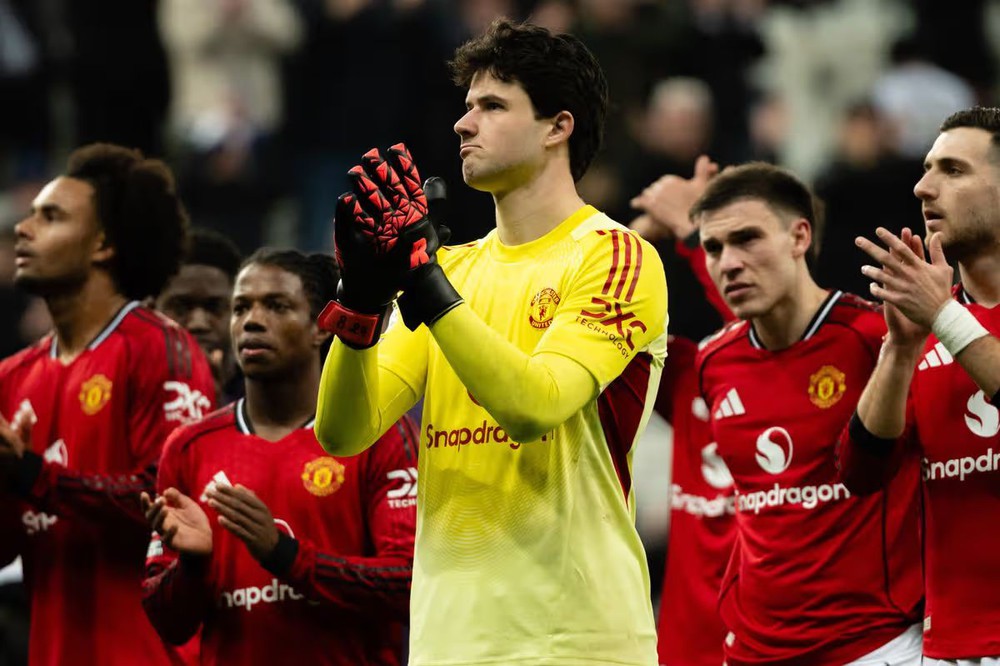
The loss to Newcastle exposed weaknesses in personnel, both on the touchline and on the pitch.
In the initial matches under Carrick, the midfield's dynamism allowed United to play faster and more directly. These three players have seen little rotation due to their oversized influence on the team's style, leading to a drop in their activity levels and performance quality.
Carrick or Not?
In the Newcastle defeat, the most visible sign was the larger-than-usual gaps between the lines. Pressing actions were often half a step late, and transitions, a crucial weapon, lacked sharpness. Attacking phases became prolonged, with the ball circulated laterally before finding space. Fewer players were arriving in dangerous areas.
Several reasons contribute to this: accumulated fatigue, resulting in less explosive movement, and issues with the attacking structure. Often, the midfield line wasn't positioned close enough to support short combinations, while forwards frequently received the ball with their backs to goal.
This made United's build-up predictable. While they failed to generate attacking threat from the wide areas, it allowed Newcastle's defensive block to remain stable and launch counter-attacks, one of which led to the Magpies' decisive goal.
This highlights Carrick's struggle to manage in-game pressure. He couldn't help the players break the game's stifling pattern or effectively leverage the squad's personnel advantages and overall form.
The 45-year-old coach fell into a pattern common among young or inexperienced managers: sticking rigidly to a core framework for stability to maximize winning chances, while lacking flexibility in squad rotation and failing to capitalize on scheduling factors.
Manchester United aims to build a squad capable of competing for major trophies, but it faces crucial issues regarding squad depth and managerial experience. The team needs to add quality players across multiple positions. This leads to another significant question: should they continue placing faith in the 45-year-old coach, or opt for someone with proven experience and the ability to manage the club's sporting project?



 Links
Links
 Contact
Address:123
Number:+123
E-mali:i123@gmail.com
 App
App