



Liverpool: Losing in stoppage time has become a habit.



From being a formidable power that intimidated the Premier League during injury time, the home team at Anfield has now turned into a regular casualty of late concessions.
The statistics don't lie: Liverpool have lost 5 Premier League matches due to goals conceded in the 90th minute or later, the highest number any team has suffered in a single season. These are no longer isolated incidents, but an alarming trend—a "late-minute disease" threatening the ambitions of manager Arne Slot and his squad.
The 90th-minute ailment
The 1-2 defeat to Wolves at Molineux is a prime example. Wolves, a team languishing at the bottom of the table and considered relegation candidates, only registered their first shot on target in the 78th minute, yet it was enough to open the scoring. Liverpool equalized through Mohamed Salah, but just as everyone anticipated a familiar comeback, they were dealt a cold blow in the 90+4th minute. Andre's shot took a deflection off Gomez, leaving goalkeeper Alisson helpless and sealing another haunting night.
Notably, Wolves are not an isolated case. Previously, Liverpool have collapsed in similar fashion against Man City, Chelsea, Bournemouth, and Crystal Palace. They were also held to draws by Fulham and Leeds during stoppage time. When a scenario repeats itself so frequently, it can no longer be attributed to mere bad luck. Over the previous seven seasons, Liverpool averaged only one loss per year due to late goals. The sharp increase this season is therefore even more shocking. The team once famous for finishing off opponents at the last moment has now made itself the victim.
A closer analysis reveals that these late goals are not solely due to opponent pressure. Many situations stem from individual errors or poor decision-making. At Molineux, a chain of mistakes unfolded: losing possession in midfield, failing to contest fiercely, making unsafe back-passes, and then failing to close down the shooter in time. All combined into one fateful moment.
Captain Virgil van Dijk did not shy away from reality, admitting the entire team played sluggishly, predictably, and carelessly. His words reflect the general sentiment: Liverpool can no longer maintain their composure and coolness at decisive moments.
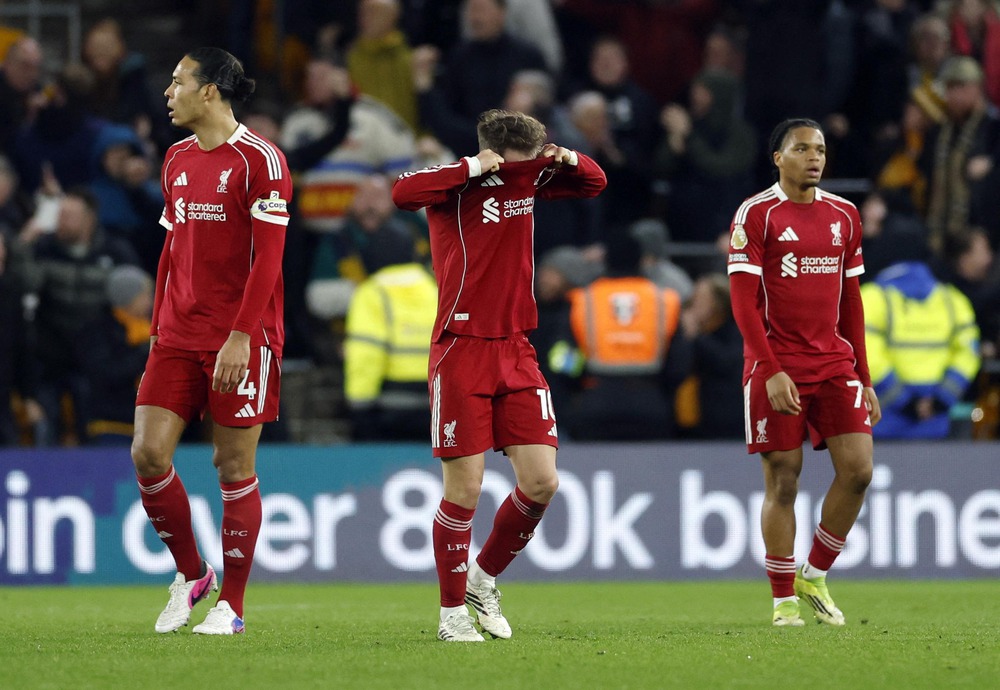
The post-90th-minute affliction is costing Liverpool dearly
A systemic issue
Liverpool's problem isn't confined to defense. Manager Arne Slot has repeatedly pointed out a paradox: his team dominates possession, creates more chances than opponents, yet struggles to score from open play. Recently, they have relied heavily on set-pieces to find goals.
This attacking inefficiency often forces Liverpool into a desperate, all-out push late in games. In their intense desire to win, they push the team higher up, inadvertently losing balance. The philosophy of "if you can't win, at least don't lose" seems absent from their current approach.
In reality, during many late losses, Liverpool have made substitutions geared towards boosting attack, which simultaneously weakened the defensive structure. In fact, 3 of their last 4 defeats from late goals occurred when a key defensive pillar was off the pitch. This raises questions about the coaching staff's match-reading and situational awareness.
Psychology is also a significant factor. Repeated blows in stoppage time gradually erode confidence. A sense of unease now surfaces whenever the clock ticks past the 90th minute. A team once famed for fighting spirit until the final whistle now appears fragile at that very moment.
The defeat to Wolves was particularly painful due to its symbolic nature. It was a loss to the bottom-placed team, at a time when Liverpool needed points to secure a European qualification spot. When an opportunity to build momentum for the final stretch presented itself, they threw it away with a familiar mistake.
Nine match rounds remain. The door to the Champions League hasn't closed, but the pressure is mounting. If they don't thoroughly cure this "90th-minute disease," all their efforts in controlling possession and creating chances will be rendered meaningless.
This Liverpool season can be summed up by a phrase uttered by Arne Slot himself: "The same old story repeating." A team that dominates matches but lacks sharpness, pushes high for victory but sacrifices safety, then collapses at the moment danger seemed to have passed.
Liverpool built their reputation on nerve-shredding last-minute victories. But this year, they stand out for the opposite reason. To salvage their season, The Kop must rediscover their resilience and necessary pragmatism. Because in top-level football, sometimes the most important thing isn't scoring in the 90th minute, but avoiding conceding in it.



 Links
Links
 Contact
Address:123
Number:+123
E-mali:i123@gmail.com
 App
App